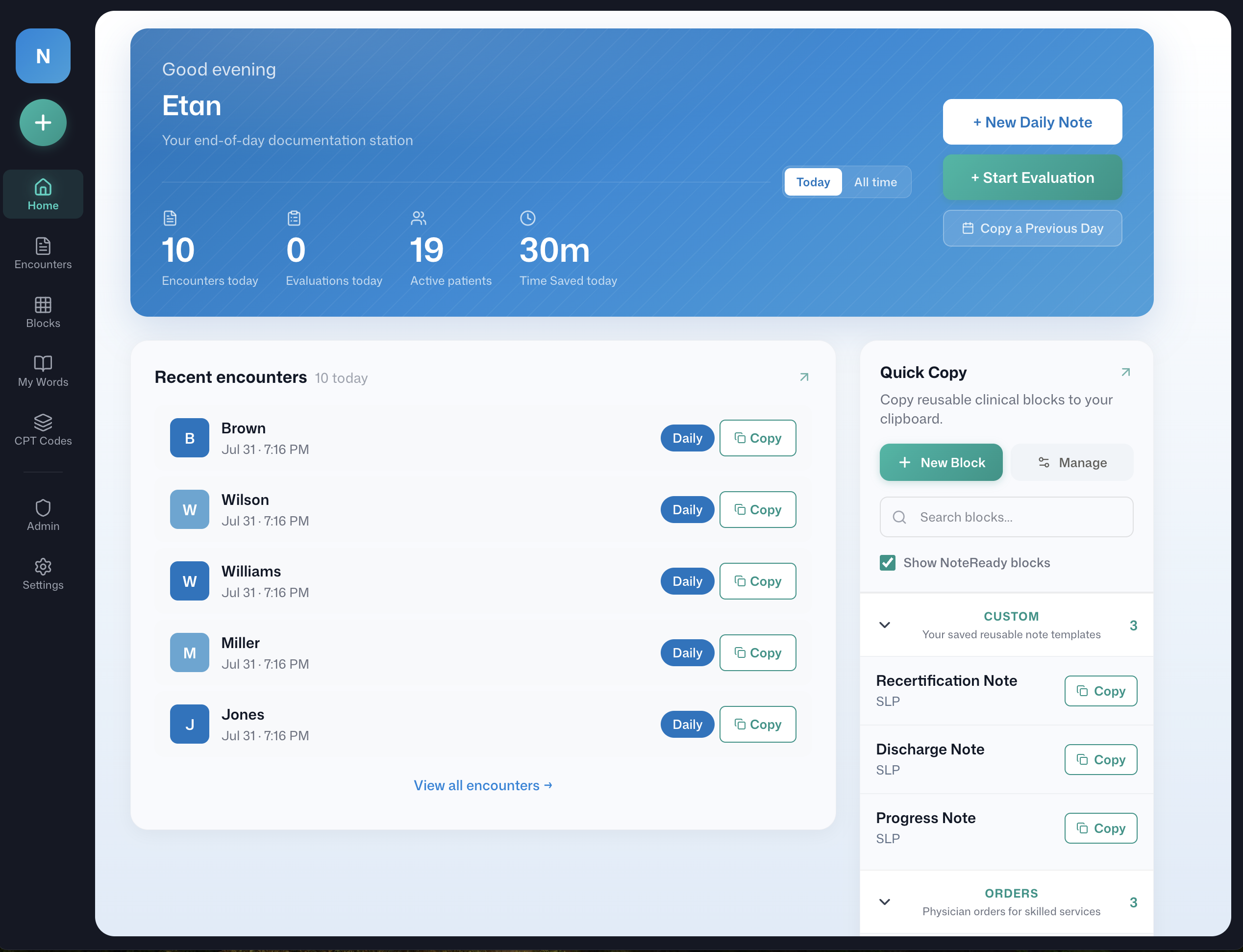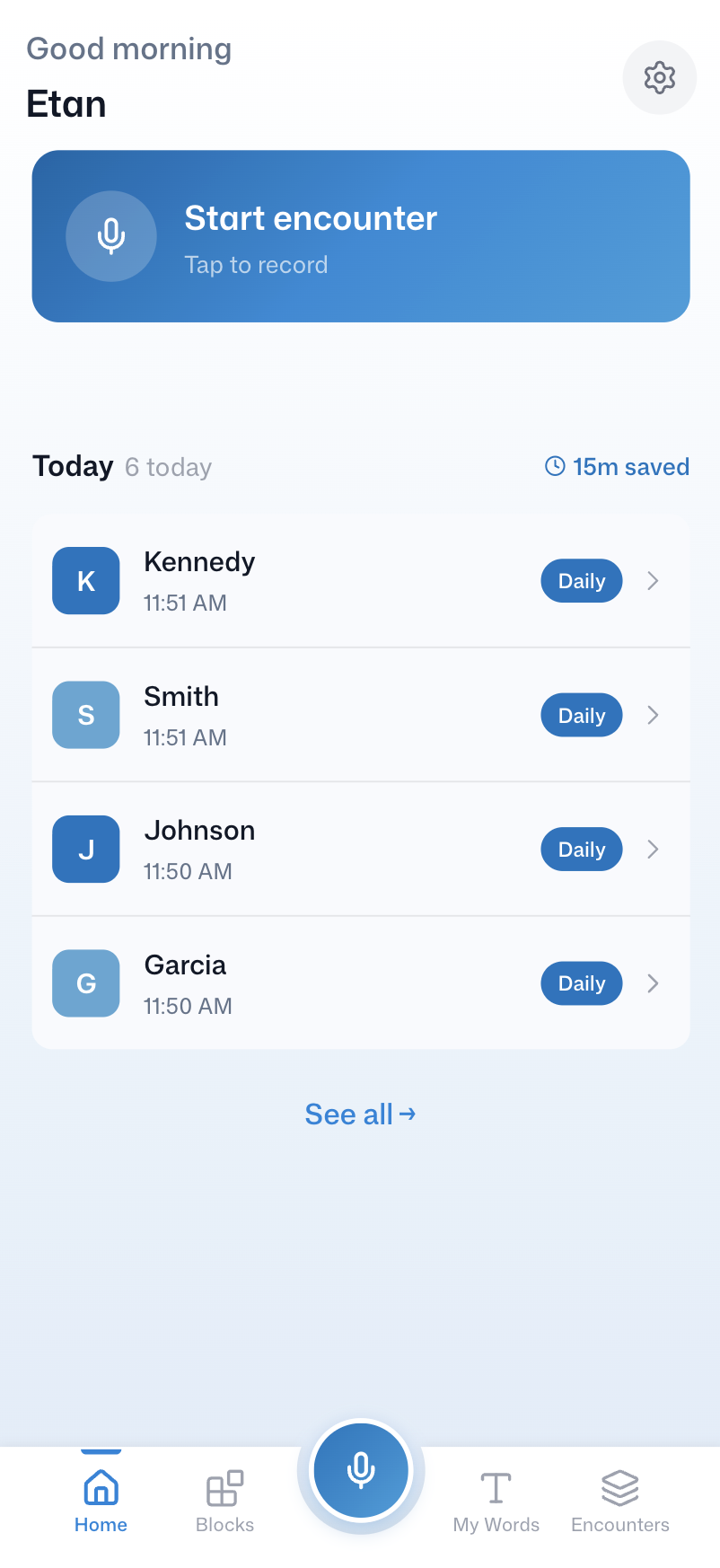
NoteReady reduces non-billable documentation time and gives therapists that time back, creating the potential for improved productivity without adding staff or paid hours.
Real usage data from practicing therapists documenting real patient sessions, not a lab benchmark.
10 practicing therapists·5 SNF / subacute facilities
Built by an experienced SNF clinician who experienced the documentation burden firsthand. NoteReady wasn't designed from the outside looking in. It was built to solve a problem the founder lived every day at the bedside.
Traditional documentation workflows were not designed for today's productivity demands.
Therapists lose measurable hours each week to manual note entry, time that doesn't show up as billable, patient-facing care.
Documenting after treatment means recalling session detail from memory, or breaking care to document at point of service.
Documentation backlog gets pushed into evenings and off-hours, adding to workload without adding to care delivered.
A HIPAA-compliant app that works alongside the documentation system you already use. Not a new system to learn: a faster path through the one you already have.
The finished note, ready to copy into your EMR.
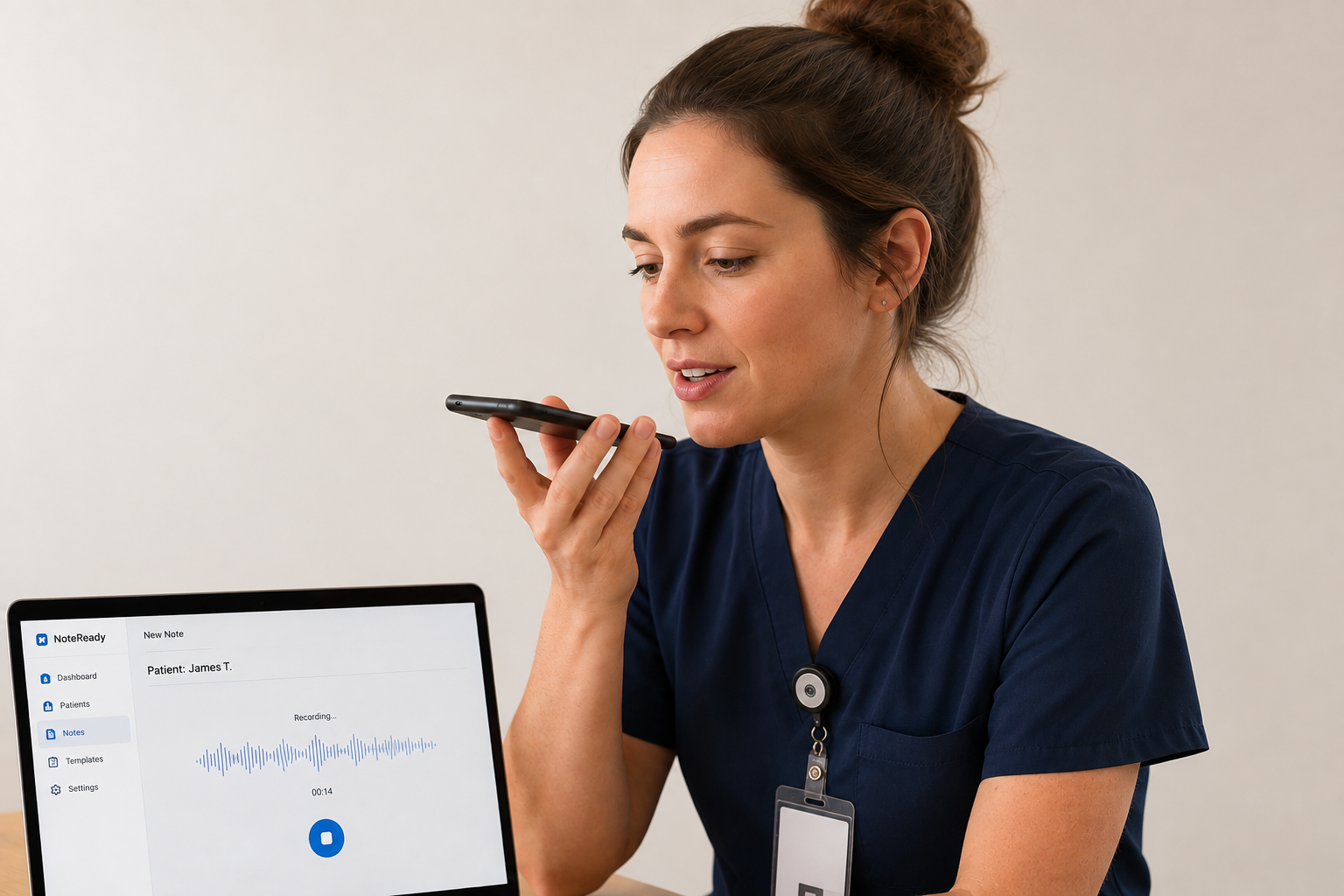
Therapist speaks naturally after treatment sessions: no templates, no structured fields, just a natural clinical account of the session.
NoteReady transforms spoken clinical information into structured documentation using rehab-specific clinical logic and terminology.
Therapist reviews the finished note and transfers it into their existing EMR workflow: no new system of record to maintain.
Built specifically for PT, OT, and SLP: discipline-specific clinical terminology and documentation logic, not generic AI writing.
Designed for SNF and subacute rehabilitation workflows specifically, not adapted from an outpatient or acute-care product.
Works alongside your existing EMR: NoteReady doesn't replace or require access to your system of record.
Optimized for Net Health workflows, and compatible with most other EMR systems used across SNF and subacute settings.
The trust foundation your clinical and compliance teams need before anything else.
Built from the ground up around HIPAA requirements for handling protected health information.
Every user signs a Business Associate Agreement as a required part of onboarding: built into how the product works, not an optional add-on.
Every user signs up with their own verified account: no shared logins, no pre-made credentials.
Works alongside your existing systems rather than replacing them or requiring direct access.
How patient information is handled: session audio and generated notes are transmitted over encrypted connections and processed through HIPAA-covered infrastructure. Protected health information is never stored in browser local storage and never written to application logs.
A general AI assistant can transcribe speech. It doesn't understand SNF documentation.
Even a 1 percentage-point improvement in therapist productivity represents meaningful recovered capacity at scale. NoteReady doesn't need to convert every recovered minute into billable treatment time to create value.
In the two-month pilot, therapists saved roughly 30-45 minutes of documentation time per day, time that can go back into patient care, caseload capacity, or therapist retention.
These figures estimate the value of recovered therapist capacity — the compensation-equivalent value of hours a productivity gain frees up, not projected revenue.
Percentage points, not percent. Example: 85% productivity → 86% productivity is a 1 percentage-point improvement.
Based on 100 therapists and a 1 percentage-point productivity improvement.
Based on approximately 250 working days per year, 8 paid hours per day, and therapist compensation of $37–$50/hour. Actual productivity gains vary by facility, caseload mix, baseline documentation time, staffing model, and workflow.
Free. No obligation. Measure the impact before you decide.
Begin with one or two facilities and a defined group of therapists. We establish baseline usage and productivity metrics, provide onboarding and adoption support, and measure the impact of NoteReady in the real clinical workflow.
This is a free, low-friction, evidence-based pilot. Onboarding for pilot engagements is led directly by NoteReady's founder, a practicing SNF clinician who understands the workflow firsthand. Day 45 is a shared point to review real data and decide together, not a deadline to commit.
Successful adoption comes from experiencing the workflow firsthand, not from being told to switch.
Our pilot showed that adoption is the critical first step.
Once therapists incorporated NoteReady into their workflow, regular users continued using it consistently after the pilot. That's why enterprise pilots include hands-on onboarding, early check-ins, and adoption support rather than simply giving therapists access and hoping they use it.
"I went from 1 hour of documentation on average to under 30 minutes. It's changed my entire relationship with my job."
Clinical perspective: as a practicing SLP, the founder built NoteReady around the actual bottleneck: not typing speed, but the gap between how therapists naturally describe a session and how documentation systems ask them to enter it. That's what turns an hour of documentation into thirty minutes or less.
"Using NoteReady makes the quality of my documentation better, because what I may have cut short to save time while typing, I am more easily able to include through dictation."
"The AI actually understands OT terminology. It nails functional activity documentation every time."
"I recommended this to our whole therapy team. Three of us are using it now."
"I now am truly able to spend time with my patients, not in front of my computer."
Start with a 60-day pilot at one or two facilities. Review the productivity impact together at the day-45 mark, before deciding whether to scale across your organization.